


 |
 |
 |
 |
|
 |
 |
79
Relativity: The Special and General Theory
It may be added that, according to the theory, half of
this deflection is produced
by the Newtonian field of attraction of the sun, and the other half by the geometrical modification ("
curvature ") of space caused by the sun.
This result admits of an experimental test by means of the photographic registration of stars during
a total eclipse of the sun. The only reason why we must wait for a total eclipse is because at every
other time the atmosphere is so strongly illuminated by the light from the sun that the stars situated
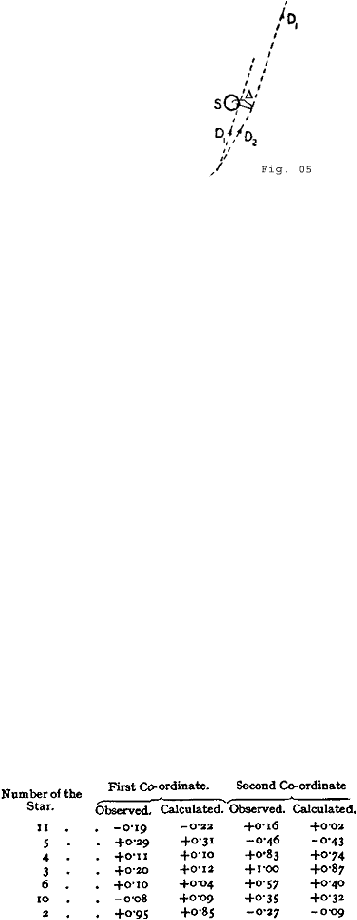
near the sun's disc are invisible. The predicted effect can be seen clearly from the accompanying
diagram. If the sun (S) were not present, a star which is practically infinitely distant would be seen
in the direction D1, as observed front the earth. But as a consequence of the deflection of light from
the star by the sun, the star will be seen in the direction D2, i.e. at a somewhat greater distance
from the centre of the sun than corresponds to its real position.
In practice, the question is tested in the following way. The stars in the neighbourhood of the sun
are photographed during a solar eclipse. In addition, a second photograph of the same stars is
taken when the sun is situated at another position in the sky, i.e. a few months earlier or later. As
compared whh the standard photograph, the positions of the stars on the eclipse?photograph
ought to appear displaced radially outwards (away from the centre of the sun) by an amount
corresponding to the angle a.
We are indebted to the [British] Royal Society and to the Royal Astronomical Society for the
investigation of this important deduction. Undaunted by the [first world] war and by difficulties of
both a material and a psychological nature aroused by the war, these societies equipped two
expeditions — to Sobral (Brazil), and to the island of Principe (West Africa) — and sent several of
Britain's most celebrated astronomers (Eddington, Cottingham, Crommelin, Davidson), in order to
obtain photographs of the solar eclipse of 29th May, 1919. The relative discrepancies to be
expected between the stellar photographs obtained during the eclipse and the comparison
photographs amounted to a few hundredths of a millimetre only. Thus great accuracy was
necessary in making the adjustments required for the taking of the photographs, and in their
subsequent measurement.
The results of the measurements confirmed the theory in a thoroughly satisfactory manner. The
rectangular components of the observed and of the calculated deviations of the stars (in seconds of
arc) are set forth in the following table of results :