


 |
 |
 |
 |
|
 |
 |
78
Relativity: The Special and General Theory
again to a minimum. If instead of Newton's law we insert a somewhat different law of attraction into
the calculation, we find that, according to this new law, the motion would still take place in such a
manner that the distance sun?planet exhibits periodic variations; but in this case the angle
described by the line joining sun and planet during such a period (from perihelion—closest
proximity to the sun—to perihelion) would differ from 360
0
.
The line of the orbit would not then be a
closed one but in the course of time it would fill up an annular part of the orbital plane, viz. between
the circle of least and the circle of greatest distance of the planet from the sun.
According also to the general theory of relativity, which differs of course from the theory of Newton,
a small variation from the Newton?Kepler motion of a planet in its orbit should take place, and in
such away, that the angle described by the radius sun?planet between one perhelion and the next
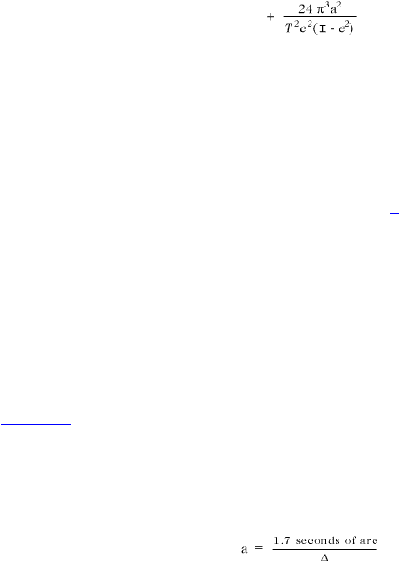
should exceed that corresponding to one complete revolution by an amount given by
(N.B. — One complete revolution corresponds to the angle 2A in the absolute angular measure
customary in physics, and the above expression giver the amount by which the radius sun?planet
exceeds this angle during the interval between one perihelion and the next.) In this expression
a represents the major semi?axis of the ellipse, e its eccentricity, c the velocity of light, and T the
period of revolution of the planet. Our result may also be stated as follows : According to the
general theory of relativity, the major axis of the ellipse rotates round the sun in the same sense as
the orbital motion of the planet. Theory requires that this rotation should amount to 43 seconds of
arc per century for the planet Mercury, but for the other Planets of our solar system its magnitude
should be so small that it would necessarily escape detection.
1)
In point of fact, astronomers have found that the theory of Newton does not suffice to calculate the
observed motion of Mercury with an exactness corresponding to that of the delicacy of observation
attainable at the present time. After taking account of all the disturbing influences exerted on
Mercury by the remaining planets, it was found (Leverrier: 1859; and Newcomb: 1895) that an
unexplained perihelial movement of the orbit of Mercury remained over, the amount of which does
not differ sensibly from the above mentioned +43 seconds of arc per century. The uncertainty of the
empirical result amounts to a few seconds only.
(b) Deflection of Light by a Gravitational Field
In Section 22 it has been already mentioned that according to the general theory of relativity, a ray
of light will experience a curvature of its path when passing through a gravitational field, this
curvature being similar to that experienced by the path of a body which is projected through a
gravitational field. As a result of this theory, we should expect that a ray of light which is passing
close to a heavenly body would be deviated towards the latter. For a ray of light which passes the
sun at a distance of ” sun?radii from its centre, the angle of deflection (a) should amount to