


 |
 |
 |
 |
|
 |
 |
80
Relativity: The Special and General Theory
(c) Displacement of Spectral Lines Towards the Red
In Section 23 it has been shown that in a system K¹ which is in rotation with regard to a Galileian
system K, clocks of identical construction, and which are considered at rest with respect to the
rotating reference?body, go at rates which are dependent on the positions of the clocks. We shall
now examine this dependence quantitatively. A clock, which is situated at a distance r from the
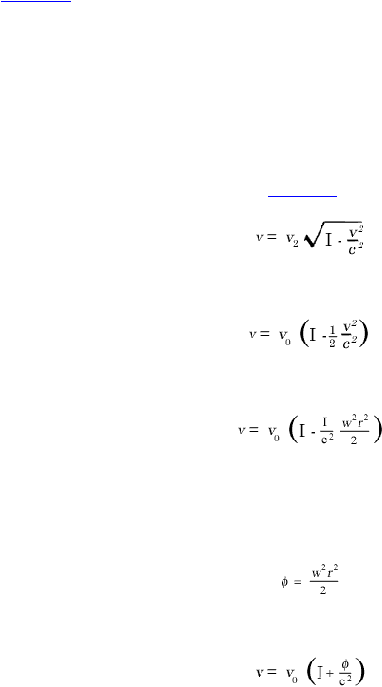
centre of the disc, has a velocity relative to K which is given by
V = wr
where w represents the angular velocity of rotation of the disc K¹ with respect to K. If v
0
,
represents
the number of ticks of the clock per unit time (" rate " of the clock) relative to K when the clock is at
rest, then the " rate " of the clock (v) when it is moving relative to K with a velocity V, but at rest with
respect to the disc, will, in accordance with Section 12, be given by
or with sufficient accuracy by
This expression may also be stated in the following form:
If we represent the difference of potential of the centrifugal force between the position of the clock
and the centre of the disc by ?, i.e. the work, considered negatively, which must be performed on
the unit of mass against the centrifugal force in order to transport it from the position of the clock on
the rotating disc to the centre of the disc, then we have
From this it follows that
In the first place, we see from this expression that two clocks of identical construction will go at
different rates when situated at different distances from the centre of the disc. This result is aiso
valid from the standpoint of an observer who is rotating with the disc.
Now, as judged from the disc, the latter is in a gravititional field of potential ?, hence the result we
have obtained will hold quite generally for gravitational fields. Furthermore, we can regard an atom
which is emitting spectral lines as a clock, so that the following statement will hold:
An atom absorbs or emits light of a frequency which is dependent on the potential of the
gravitational field in which it is situated.