


 |
 |
 |
 |
|
 |
 |
73
Relativity: The Special and General Theory
But from what has been said, the two snapshots must be identical; hence ”x in (7) must be equal to
”x' in (7a), so that we obtain
The equations (6) and (7b) determine the constants a and b. By inserting the values of these
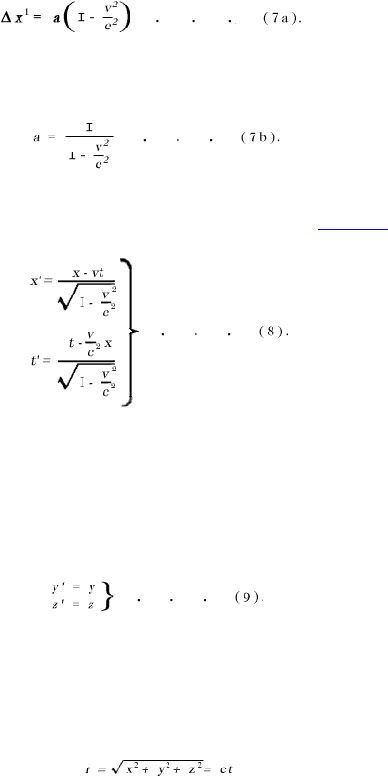
constants in (5), we obtain the first and the fourth of the equations given in Section 11.
Thus we have obtained the Lorentz transformation for events on the x?axis. It satisfies the
condition
x'² ? c²t'² = x² ? c²t²
.
.
.
(8a).
The extension of this result, to include events which take place outside the x?axis, is obtained by
retaining equations (8) and supplementing them by the relations
In this way we satisfy the postulate of the constancy of the velocity of light in vacuo for rays of light
of arbitrary direction, both for the system K and for the system K'. This may be shown in the
following manner.
We suppose a light?signal sent out from the origin of K at the time t = 0. It will be propagated
according to the equation
or, if we square this equation, according to the equation
x² + y² + z² = c²t² = 0
.
.
.
(10).
It is required by the law of propagation of light, in conjunction with the postulate of relativity, that the
transmission of the signal in question should take place — as judged from K¹ — in accordance with
the corresponding formula
r' = ct'