


 |
 |
 |
 |
|
 |
 |
72
Relativity: The Special and General Theory
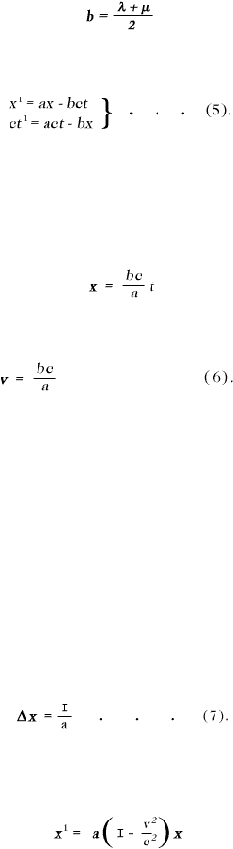
we obtain the equations
We should thus have the solution of our problem, if the constants a and b were known. These
result from the following discussion.
For the origin of K¹ we have permanently x' = 0, and hence according to the first of the equations
(5)
If we call v the velocity with which the origin of K¹ is moving relative to K, we then have
The same value v can be obtained from equations (5), if we calculate the velocity of another point
of K¹ relative to K, or the velocity (directed towards the negative x?axis) of a point of K with respect
to K'. In short, we can designate v as the relative velocity of the two systems.
Furthermore, the principle of relativity teaches us that, as judged from K, the length of a unit
measuring?rod which is at rest with reference to K¹ must be exactly the same as the length, as
judged from K', of a unit measuring?rod which is at rest relative to K. In order to see how the points
of the x?axis appear as viewed from K, we only require to take a " snapshot " of K¹ from K; this
means that we have to insert a particular value of t (time of K), e.g. t = 0. For this value of t we then
obtain from the first of the equations (5)
x' = ax
Two points of the x'?axis which are separated by the distance ”x' = I when measured in the
K¹ system are thus separated in our instantaneous photograph by the distance
But if the snapshot be taken from K'(t' = 0), and if we eliminate t from the equations (5), taking into
account the expression (6), we obtain
From this we conclude that two points on the x?axis separated by the distance I (relative to K) will
be represented on our snapshot by the distance