


 |
 |
 |
 |
|
 |
 |
69
Relativity: The Special and General Theory
Albert Einstein: Relativity
Part III: Considerations on the Universe as a Whole
The Structure of Space
According to the General
Theory of Relativity
According to the general theory of relativity, the geometrical properties of space are not
independent, but they are determined by matter. Thus we can draw conclusions about the
geometrical structure of the universe only if we base our considerations on the state of the matter
as being something that is known. We know from experience that, for a suitably chosen
co?ordinate system, the velocities of the stars are small as compared with the velocity of
transmission of light. We can thus as a rough approximation arrive at a conclusion as to the nature
of the universe as a whole, if we treat the matter as being at rest.
We already know from our previous discussion that the behaviour of measuring?rods and clocks is
influenced by gravitational fields, i.e. by the distribution of matter. This in itself is sufficient to
exclude the possibility of the exact validity of Euclidean geometry in our universe. But it is
conceivable that our universe differs only slightly from a Euclidean one, and this notion seems all
the more probable, since calculations show that the metrics of surrounding space is influenced only
to an exceedingly small extent by masses even of the magnitude of our sun. We might imagine
that, as regards geometry, our universe behaves analogously to a surface which is irregularly
curved in its individual parts, but which nowhere departs appreciably from a plane: something like
the rippled surface of a lake. Such a universe might fittingly be called a quasi?Euclidean universe.
As regards its space it would be infinite. But calculation shows that in a quasi?Euclidean universe
the average density of matter would necessarily be nil. Thus such a universe could not be inhabited
by matter everywhere ; it would present to us that unsatisfactory picture which we portrayed in
Section 30.
If we are to have in the universe an average density of matter which differs from zero, however
small may be that difference, then the universe cannot be quasi?Euclidean. On the contrary, the
results of calculation indicate that if matter be distributed uniformly, the universe would necessarily
be spherical (or elliptical). Since in reality the detailed distribution of matter is not uniform, the real
universe will deviate in individual parts from the spherical, i.e. the universe will be quasi?spherical.
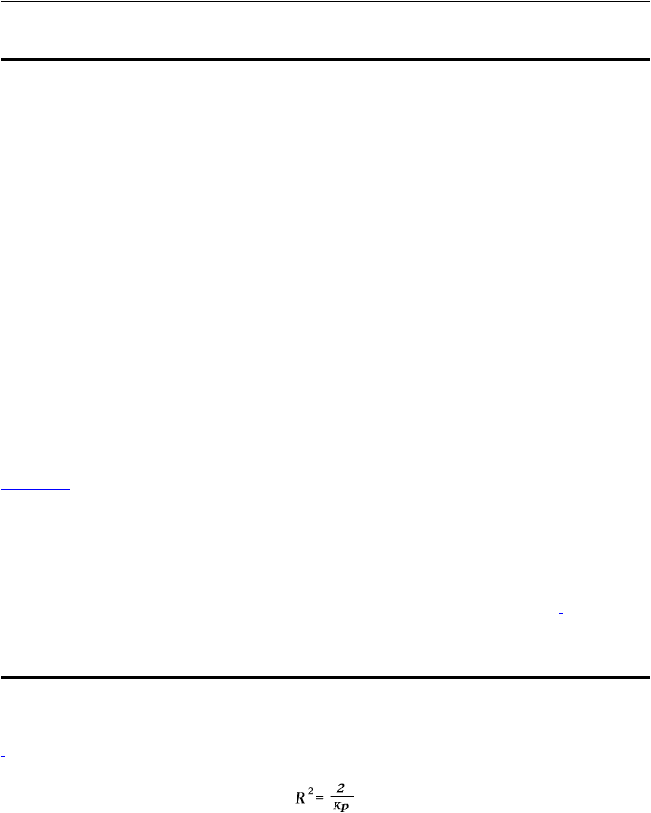
But it will be necessarily finite. In fact, the theory supplies us with a simple connection ¹
)
between
the space?expanse of the universe and the average density of matter in it.
Footnotes
1
)
For the radius R of the universe we obtain the equation
The use of the C.G.S. system in this equation gives 2/k = 1
.
08.10²
7
;
p is the average density of the
matter and k is a constant connected with the Newtonian constant of gravitation.