


 |
 |
 |
 |
|
 |
 |
53
Relativity: The Special and General Theory
Albert Einstein: Relativity
Part II: The General Theory of Relativity
Gaussian Co?ordinates
According to Gauss, this combined analytical and geometrical mode of handling the problem can
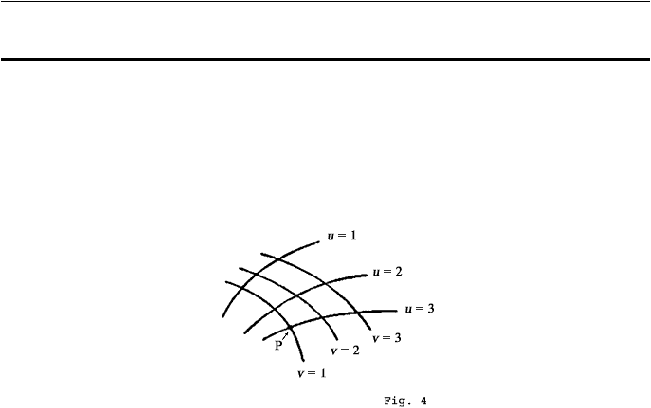
be arrived at in the following way. We imagine a system of arbitrary curves (see Fig. 4) drawn on
the surface of the table. These we designate as u?curves, and we indicate each of them by means
of a number. The Curves u= 1, u= 2 and u= 3 are drawn in the diagram. Between the curves u= 1
and u= 2 we must imagine an infinitely large number to be drawn, all of which correspond to real
numbers lying between 1 and 2.
We have then a system of
u?curves, and this "infinitely dense" system covers the whole surface of the table. These u?curves
must not interseect each other, and through each point of the surface one and only one curve must
pass. Thus a perfectly definite value of u belongs to every point on the surface of the marble slab.
In like manner we imagine a system of v?curves drawn on the surface. These satisfy the same
conditions as the u?curves, they are provided with numbers in a corresponding manner, and they
may likewise be of arbitrary shape. It follows that a value of u and a value of v belong to every point
on the surface of the table. We call these two numbers the co?ordinates of the surface of the table
(Gaussian co?ordinates). For example, the point P in the diagram has the Gaussian co?ordinates
u= 3, v= 1. Two neighbouring points P and P¹ on the surface then correspond to the co?ordinates
P:
u,v
P¹:
u + du, v + dv,
where du and dv signify very small numbers. In a similar manner we may indicate the distance
(line?interval) between P and P¹, as measured with a little rod, by means of the very small number
ds. Then according to Gauss we have
ds² = g11du² + 2g12dudv = g22dv²
where g11, g12, g22, are magnitudes which depend in a perfectly definite way on u and v. The
magnitudes g11, g
12
and g22, determine the behaviour of the rods relative to the u?curves and
v?curves, and thus also relative to the surface of the table. For the case in which the points of the
surface considered form a Euclidean continuum with reference to the measuring?rods, but only in
this case, it is possible to draw the u?curves and v?curves and to attach numbers to them, in such
a manner, that we simply have :
ds² = du² + dv²