


 |
 |
 |
 |
|
 |
 |
32
Relativity: The Special and General Theory
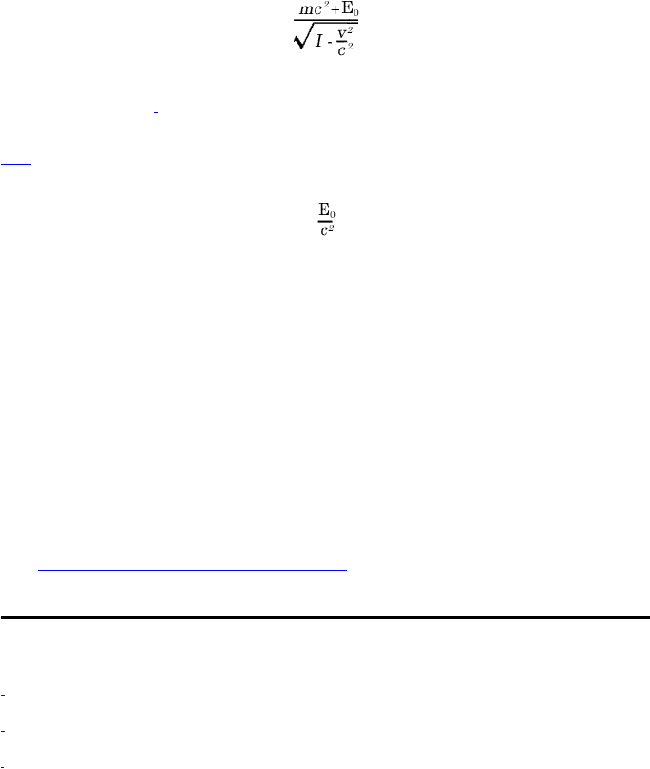
we see that the term mc², which has hitherto attracted our attention, is nothing else than the energy
possessed by the body ²
)
before it absorbed the energy E
0
.
A direct comparison of this relation with experiment is not possible at the present time (1920; see
Note, p. 48), owing to the fact that the changes in energy E
0
to which we can Subject a system are
not large enough to make themselves perceptible as a change in the inertial mass of the system.
is too small in comparison with the mass m, which was present before the alteration of the energy.
It is owing to this circumstance that classical mechanics was able to establish successfully the
conservation of mass as a law of independent validity.
Let me add a final remark of a fundamental nature. The success of the Faraday?Maxwell
interpretation of electromagnetic action at a distance resulted in physicists becoming convinced
that there are no such things as instantaneous actions at a distance (not involving an intermediary
medium) of the type of Newton's law of gravitation. According to the theory of relativity, action at a
distance with the velocity of light always takes the place of instantaneous action at a distance or of
action at a distance with an infinite velocity of transmission. This is connected with the fact that the
velocity c plays a fundamental role in this theory. In Part II we shall see in what way this result
becomes modified in the general theory of relativity.
Next: Experience and the Special Theory of Relativity
Footnotes
1
)
E
0
is the energy taken up, as judged from a co?ordinate system moving with the body.
2
)
As judged from a co?ordinate system moving with the body.
[
Note]
With the advent of nuclear transformation processes, which result from the bombardment of
elements by ±?particles, protons, deuterous, neutrons or ?
?
rays, the equivalence of mass and
energy expressed by the ralation E = mc² has been amply confirmed. The sum of the reacting
masses, together with the mass equivalent of the kinetic energy of the bombarding particle (or
photon), is always greater than the sum of the resulting masses. The difference is the equivalent
mass of the kinetic energy of the particles generated, or of the released electromagnetic energy
(?
?
photons). In the same way, the mass of a spontaneously disintegrating radioactive atom is
always greater than the sum of the masses of the resulting atoms by the mass equivalent of the
kinetic energy of the particles generated (or of the photonic energy). Measurements of the energy
of the rays emitted in nuclear reactions, in combination with the equations of such reactions, render
it possible to evaluate atomic weights to a high degree of accuracy. [Note by the translator]