


 |
 |
 |
 |
|
 |
 |
Relativity: The Special and General Theory
27
by some of the best experimental physicists, so that there can be no doubt about its result. The
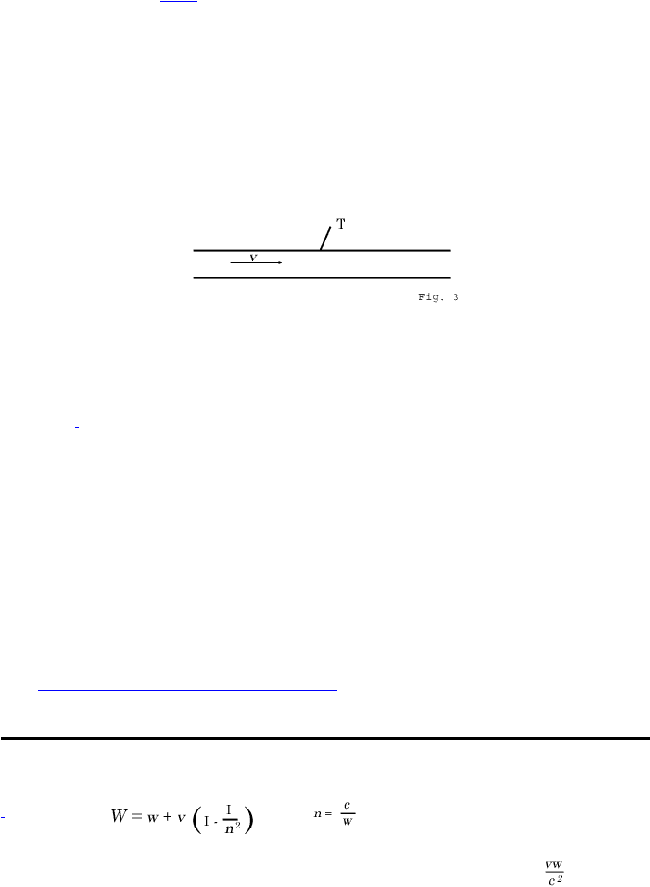
experiment is concerned with the following question. Light travels in a motionless liquid with a
particular velocity w. How quickly does it travel in the direction of the arrow in the tube T (see the
accompanying diagram, Fig. 3) when the liquid above mentioned is flowing through the tube with a
velocity v ?
In accordance with the principle of relativity we shall certainly have to take for granted that the
propagation of light always takes place with the same velocity w with respect to the liquid, whether
the latter is in motion with reference to other bodies or not. The velocity of light relative to the liquid
and the velocity of the latter relative to the tube are thus known, and we require the velocity of light
relative to the tube.
It is clear that we have the problem of Section 6 again before us. The tube plays the part of the
railway embankment or of the co?ordinate system K, the liquid plays the part of the carriage or of
the co?ordinate system K¹, and finally, the light plays the part of the
man walking along the carriage, or of the moving point in the present section. If we denote the
velocity of the light relative to the tube by W, then this is given by the equation (A) or (B), according
as the Galilei transformation or the Lorentz transformation corresponds to the facts.
Experiment¹
)
decides in favour of equation (B) derived from the theory of relativity, and the
agreement is, indeed, very exact. According to recent and most excellent measurements by
Zeeman, the influence of the velocity of flow v on the propagation of light is represented by formula
(B) to within one per cent.
Nevertheless we must now draw attention to the fact that a theory of this phenomenon was given
by H. A. Lorentz long before the statement of the theory of relativity. This theory was of a purely
electrodynamical nature, and was obtained by the use of particular hypotheses as to the
electromagnetic structure of matter. This circumstance, however, does not in the least diminish the
conclusiveness of the experiment as a crucial test in favour of the theory of relativity, for the
electrodynamics of Maxwell?Lorentz, on which the original theory was based, in no way opposes
the theory of relativity. Rather has the latter been developed trom electrodynamics as an
astoundingly simple combination and generalisation of the hypotheses, formerly independent of
each other, on which electrodynamics was built.
Next: The Heuristic Value of the Theory of Relativity
Footnotes
1
)
Fizeau found
, where
is the index of refraction of the liquid. On the other hand, owing to the smallness of
as