


 |
 |
 |
 |
|
 |
 |
25
Relativity: The Special and General Theory
obtained a contraction of the rod as a consequence of its motion.
Let us now consider a seconds?clock which is permanently situated at the origin (x¹=0) of K¹. t¹=0
and t¹=I are two successive ticks of this clock. The first and fourth equations of the Lorentz
transformation give for these two ticks :
t = 0
and
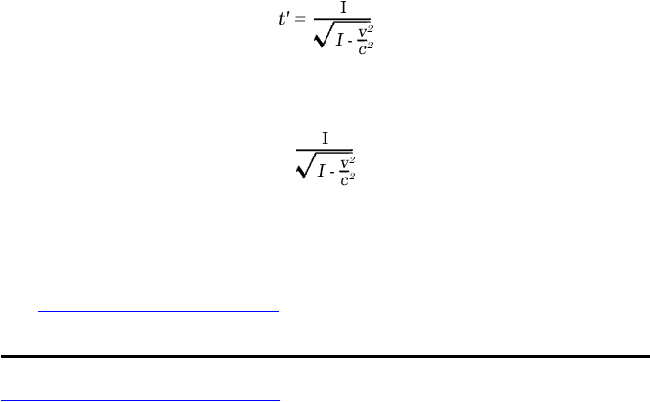
As judged from K, the clock is moving with the velocity v; as judged from this reference?body, the
time which elapses between two strokes of the clock is not one second, but
seconds, i.e. a somewhat larger time. As a consequence of its motion the clock goes more slowly
than when at rest. Here also the velocity c plays the part of an unattainable limiting velocity.
Next: Theorem of the Addition of Velocities
Relativity: The Special and General Theory