


 |
 |
 |
 |
|
 |
 |
22
Relativity: The Special and General Theory
we can disregard the fact that in reality these frameworks would continually interfere with each
other, owing to the impenetrability of solid bodies. In every such framework we imagine three
surfaces perpendicular to each other marked out, and designated as " co?ordinate planes " ("
co?ordinate system "). A co?ordinate system K then corresponds to the embankment, and a
co?ordinate system K' to the train. An event, wherever it may have taken place, would be fixed in
space with respect to K by the three perpendiculars x, y, z on the co?ordinate planes, and with
regard to time by a time value t. Relative to K¹, the same event would be fixed in respect of space
and time by corresponding values x¹, y¹, z¹, t¹, which of course are not identical with x, y, z, t. It has
already been set forth in detail how these magnitudes are to be regarded as results of physical
measurements.
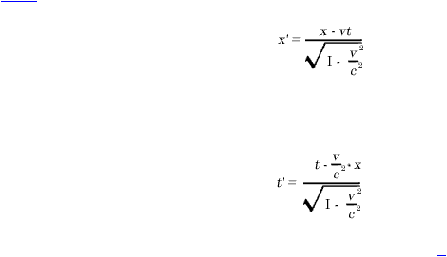
Obviously our problem can be exactly formulated in the following manner. What are the values x¹,
y¹, z¹, t¹, of an event with respect to K¹, when the magnitudes x, y, z, t, of the same event with
respect to K are given ? The relations must be so chosen that the law of the transmission of light in
vacuo is satisfied for one and the same ray of light (and of course for every ray) with respect to
K and K¹. For the relative orientation in space of the co?ordinate systems indicated in the diagram
(Fig. 2), this problem is solved by means of the equations :
y¹ = y
z¹ = z
This system of equations is known as the " Lorentz transformation."
1)
If in place of the law of transmission of light we had taken as our basis the tacit assumptions of the
older mechanics as to the absolute character of times and lengths, then instead of the above we
should have obtained the following equations:
x¹ = x ? vt
y¹ = y
z¹ = z
t¹ = t
This system of equations is often termed the " Galilei transformation." The Galilei transformation
can be obtained from the Lorentz transformation by substituting an infinitely large value for the
velocity of light c in the latter transformation.
Aided by the following illustration, we can readily see that, in accordance with the Lorentz
transformation, the law of the transmission of light in vacuo is satisfied both for the reference?body
K and for the reference?body K¹. A light?signal is sent along the positive x?axis, and this
light?stimulus advances in accordance with the equation
x = ct,
i.e. with the velocity c. According to the equations of the Lorentz transformation, this simple relation
between x and t involves a relation between x¹ and t¹. In point of fact, if we substitute for x the